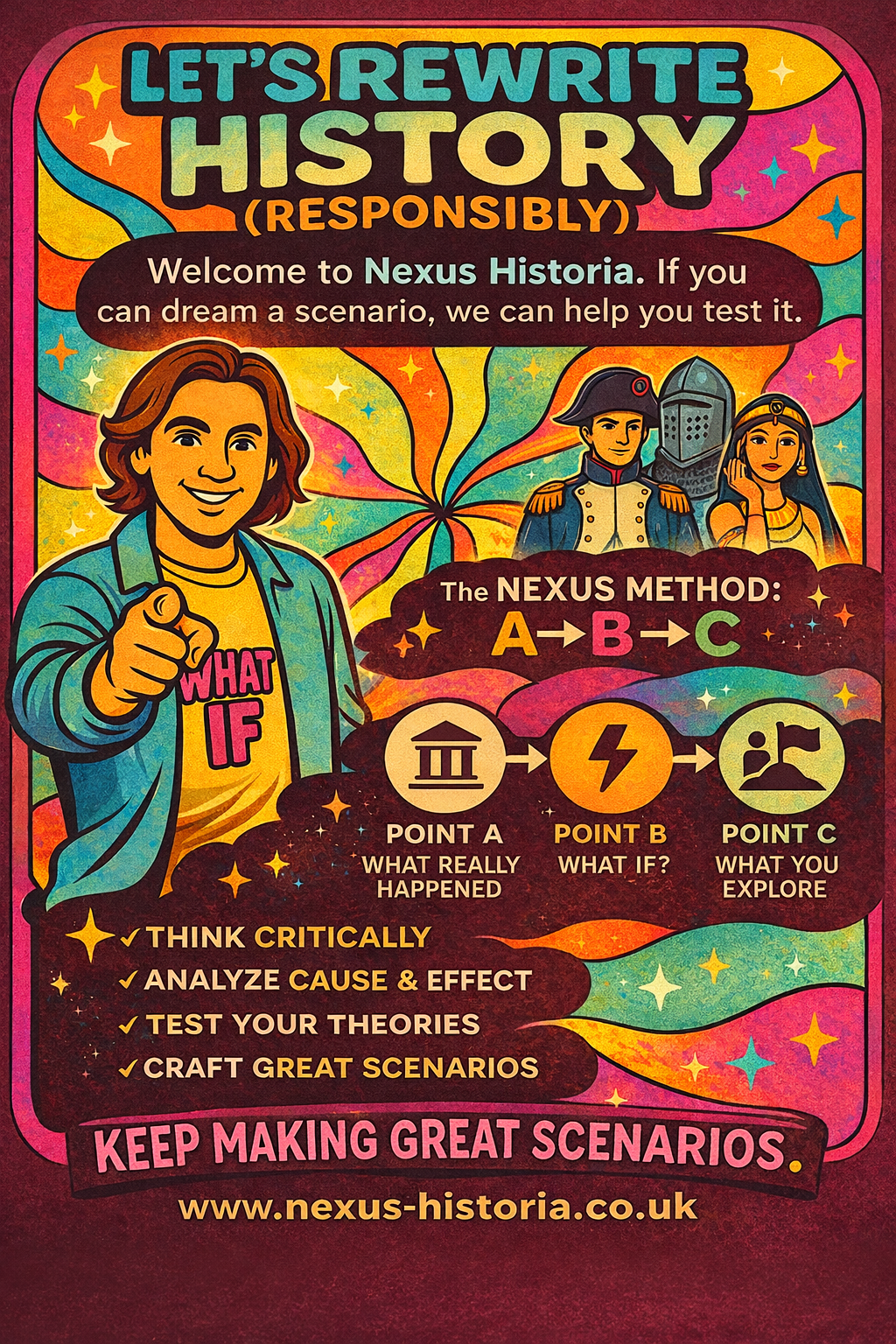
Welcome to Nexus Historia — let’s rewrite history (responsibly) If you’ve just joined Nexus Historia: welcome. You’re in the right place if you’ve ever paused mid-documentary, mid-lesson, or mid-argument with a single question: what if? [space-md] Nexus Historia is built for that moment—the point where curiosity meets critical thinking. We’re here to help you explore alternate histories in a way that’s imaginative, structured, and grounded in cause-and-effect reasoning. [space-md] Nexus Historia is an interactive platform for building “what-if” scenarios by defining a historical baseline (Point A), introducing a divergence (Point B), and exploring a synthesised outcome (Point C). That A→B→C structure is the heart of everything you’ll do here. It keeps scenarios clear, coherent, and—most importantly—useful for thinking. [space-md] Why “what-if” is more than a fun thought experiment Alternate history isn’t about pretending facts don’t matter. It’s about understanding why they do. When you build a scenario, you’re practicing skills that transfer far beyond history: historical thinking, causal literacy, evidence-based reasoning, and critical thinking. If you’ve ever wanted a creative way to sharpen analysis, Nexus Historia is your playground. [space-md] The Nexus method: A to B to C Point A: the baseline (what really happened) Point A anchors your scenario. The stronger the baseline, the more believable your alternate timeline becomes. A good Point A includes a clear time and place, the key people, institutions, and constraints, and the pressure points (economics, technology, alliances, social movements, geography). [space-md] Think of Point A as the “rules of the world” your scenario must respect. Point B: the divergence (your “what if?” moment) Point B is where you make a single, deliberate change—then follow it honestly. A strong divergence is specific (a decision, an invention, a death that doesn’t happen, a treaty that does), plausible (consistent with the conditions at Point A), and consequential (it nudges real systems: power, trade, technology, belief, conflict). If you’re new, start with one change. One. You can always expand later. [space-md] Point C: the outcome (what the new world looks like) Point C isn’t just “and then everything is different.” It’s the result of a chain reaction. Great outcomes show second-order effects (the knock-on consequences), include trade-offs (wins often come with losses), reflect realism (path dependence and unintended consequences), and acknowledge uncertainty (some outcomes branch, and that’s okay). Point C is where your scenario becomes a test of understanding. You’re not guessing—you’re reasoning. [space-md] How to create great scenarios (without getting stuck) Start narrow, then zoom out. Begin with a local effect before you jump to global outcomes. What changes in the next week? Then the next year? Then the next decade? Big changes take time. Let the timeline breathe. [space-md] Follow incentives, not heroes. Individuals matter—but systems matter too. Ask who benefits, who loses, who adapts fastest, and who resists. Incentives create momentum. Momentum creates history. Respect constraints. Technology, logistics, geography, communication speed, economic capacity—these limits shape what’s possible. Scenarios feel real when constraints remain visible. Make it falsifiable. Write your scenario in a way that someone could challenge. What evidence supports your divergence? What assumptions could be tested? Where are the weak links? If your scenario can withstand critique, it’s strong. [space-md] Keep the tone curious, not certain. Alternate history is exploration, not prophecy. The best creators leave room for complexity: competing outcomes, unexpected backlash, fragile alliances, unintended innovations. History isn’t clean. Your scenarios don’t need to be either. [space-md] Scenario starters you can try today Try a policy pivot: a government adopts or rejects a major reform five years earlier. [space-md] Try tech timing: a key invention spreads slower or faster because of a bottleneck (materials, energy, cost, patents). Try a diplomacy break: a treaty fails to form; a coalition fractures. [space-md] Try a leadership switch: a major leader survives, resigns, loses an election, or never rises. Try a communication shift: a crucial message is delayed, intercepted, or believed. Pick one, plug it into Point B, then trace the consequences forward. [space-md] What we hope you build here We want Nexus Historia to be a place where creativity and rigour work together—where you can craft stories that are imaginative but not careless, bold but not shallow. Whether you’re a student learning cause and consequence, a teacher building engaging classroom prompts, a history enthusiast who loves rabbit holes, or a writer looking for believable worldbuilding, you belong here. [space-md] Welcome aboard Thanks for joining Nexus Historia. Your first scenario doesn’t need to be perfect—it just needs to be honest: honest about the baseline, honest about the divergence, and honest about the consequences. So open the timeline, choose your turning point, and start building. [space-md] Keep making great scenarios. [space-md] Team Nexus Historia
Nexus Historia
Welcome to Nexus Historia, let’s rewrite history (responsibly)
Join Nexus Historia to explore alternate history 'what if' scenarios. Dive into fascinating discussions and rewrite history with us today!
By Nexus Historia Editorial Team · Published · Updated
This article does not yet provide linked sources. Treat historical claims as needing independent verification.
Keep exploring
Follow the wider reading path, then turn the historical question into your own branching scenario.
Canonical article: https://nexus-historia.co.uk/blog/welcome-to-nexus-historia-lets-rewrite-history-responsibly